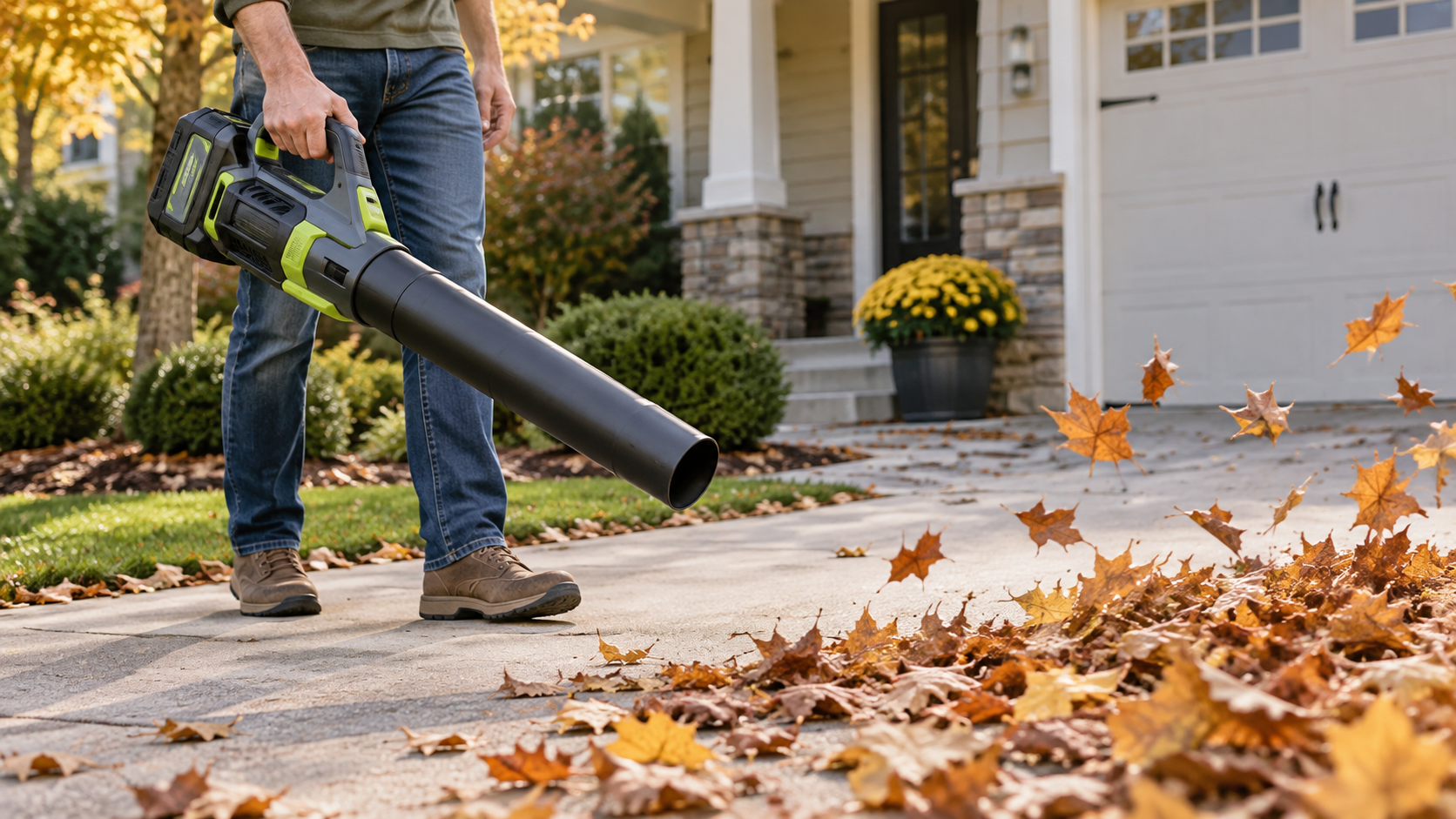
Cordless leaf blowers have improved enough that many homeowners no longer need gas for routine yard cleanup.
The challenge is that blower specs can be misleading if you look only at the biggest number on the box. CFM tells you how much air the blower moves, MPH tells you how fast that air is moving, and battery platform matters almost as much as either one.
For most homeowners, the best cordless blower is the one that gives you enough power for your yard without forcing you into an expensive new battery ecosystem you don’t need.
Quick Picks
| Pick | Model | Max Airflow | Max Airspeed | Best For |
|---|---|---|---|---|
| Best Overall | EGO Power+ 765 CFM | 765 CFM | Up to 200 MPH | Homeowners wanting strong all-around performance |
| Best Value | Ryobi 40V HP 730 CFM | 730 CFM | — | Strong performance at a lower tool-only price |
| Best for DeWalt Owners | DeWalt 20V MAX XR DCBL724B | 550 CFM | 133 MPH | Anyone already invested in DeWalt 20V batteries |
| Best for Milwaukee Owners | Milwaukee M18 FUEL 3017-20 | 500 CFM | 120 MPH | Routine cleanup within the M18 ecosystem |
| Best Heavy-Duty Alternative | Greenworks 80V 750 CFM Backpack | 750 CFM | 180 MPH | Larger properties and heavier debris |
Specifications are manufacturer-rated. Runtime and real-world performance vary with battery size, speed setting, debris, and operating conditions.
Best Overall: EGO Power+ 765 CFM
The EGO 765 CFM blower is the strongest all-around choice here for a homeowner who wants serious cordless performance without stepping into commercial equipment.
EGO rates it at up to 765 CFM, with airspeed reaching 200 MPH, and its 2026 catalog lists the tool at about 4.6 pounds without the battery. EGO also rates it for IPX4 weather resistance and pairs the kit version with a 5.0Ah battery.
Why we like it
It gives you enough airflow for heavier leaf cleanup while still being a conventional handheld blower. The 56V platform is also built around outdoor-power equipment, so the battery can carry over to mowers, trimmers, chainsaws, and other yard tools.
Potential downside
If you do not already own EGO batteries, buying into the platform costs more than purchasing a bare tool from a system you already use.
Best for
Homeowners who want one strong cordless blower that can handle both routine cleanup and heavier seasonal leaf work.
Best Value: Ryobi 40V HP 730 CFM
Ryobi’s 40V HP 730 CFM blower delivers a lot of airflow for the money.
Ryobi lists the RY404010BTL at 730 CFM, and the tool-only version is currently listed by Ryobi at $229. Ryobi also says its 40V platform works across more than 85 products.
Ryobi markets the model as part of its Whisper Series and says it is substantially quieter than comparable gas equipment. The company also offers a kit configuration with two 4Ah batteries.
Why we like it
The combination of high airflow and a broad homeowner-oriented battery ecosystem makes it a strong value proposition.
Potential downside
The 40V battery system is separate from Ryobi’s popular 18V ONE+ platform. If all your existing Ryobi tools are 18V, you are still starting a second battery system.
Best for
Homeowners who want near-premium blower power without paying premium-system pricing.
Best for DeWalt Battery Owners: DeWalt 20V MAX XR DCBL724B
If you already own DeWalt 20V MAX batteries, the DCBL724B is one of the easiest recommendations on this list.
DeWalt rates the current XR model at 550 CFM and 133 MPH. It uses a brushless motor and includes both concentrator and sweeper nozzles. DeWalt also lists up to 17 minutes of runtime at full speed when used with a DCB208 battery.
Why we like it
Battery compatibility can outweigh raw specifications.
If you already have several DeWalt batteries and chargers in the garage, purchasing a bare blower can be much more economical than buying into a completely different outdoor-power platform.
Potential downside
At 550 CFM, it does not move as much air as the EGO or Ryobi models above.
That matters more if you routinely deal with large piles of wet leaves rather than grass clippings, dry leaves, driveway debris, or garage cleanup.
Best for
DeWalt owners who want a capable blower without adding another charger and battery family.
Best for Milwaukee Battery Owners: Milwaukee M18 FUEL 3017-20
Milwaukee’s M18 FUEL 3017-20 is aimed more at fast cleanup than maximum brute-force leaf removal.
Milwaukee rates it at 500 CFM, 120 MPH, and 12.2 newtons of blowing force. The tool reaches full throttle in under a second, and Milwaukee lists the bare-tool weight at approximately 5.1 pounds.
Why we like it
The M18 platform is enormous.
If you already use Milwaukee tools, the ability to use batteries you own may be more valuable than another 150 or 200 CFM on a spec sheet.
It is also relatively quiet for a powerful handheld blower, with Milwaukee rating it at 54 dB(A) under its stated test conditions.
Potential downside
If you are starting from scratch and your main goal is simply maximum leaf-moving ability, other platforms offer more airflow.
Best for
M18 owners who need dependable driveway, patio, garage, grass-clipping, and routine yard cleanup.
Best Heavy-Duty Alternative: Greenworks 80V 750 CFM Backpack Blower
For larger yards, Greenworks offers an 80V backpack blower rated at 750 CFM and 180 MPH.
The 80V model uses a brushless motor, variable-speed trigger, turbo mode, and cruise control. Greenworks also offers versions bundled with either a 4Ah or 8Ah battery, and states that the battery works with more than 75 tools in its 80V system.
Why we like it
A backpack design moves the battery and much of the weight off your hand and wrist.
That can become important if your property requires extended blower use rather than five minutes of driveway cleanup.
Potential downside
It is larger, more expensive, and less convenient for quick grab-and-go jobs than a handheld blower.
Best for
Larger properties, longer cleanup sessions, and homeowners who regularly deal with heavier seasonal debris.
How to Choose a Cordless Leaf Blower
CFM matters more than most people realize
CFM — cubic feet per minute — measures the volume of air the blower moves.
Higher CFM generally helps move larger piles of leaves and clear wider areas.
For ordinary residential cleanup, roughly 450–600 CFM is already useful.
Once you get into the 700+ CFM range, you are moving into much stronger homeowner equipment.
MPH is only part of the story
MPH measures airspeed.
High MPH can help loosen stubborn debris, but a very fast narrow air stream does not necessarily move a big pile of leaves better than a machine with greater overall airflow.
That is why we would not choose a blower solely because its MPH number is highest.
Your existing batteries can change the answer
This may be the most important buying consideration.
Suppose one blower costs $199 tool-only while another supposedly “better” model costs $249.
If you already own three compatible batteries for the $199 blower, the real price difference may be much larger than $50 because the other tool also requires a battery and charger.
For many homeowners, staying within an existing battery system is the smartest purchase.
Think about what you actually blow
For:
Driveways, patios and grass clippings:
You probably do not need the most powerful blower available.
Average suburban yards:
A mid- to high-powered handheld unit usually makes sense.
Heavy fall leaves or larger properties:
Look toward 700+ CFM machines or backpack designs.
Wet leaves and stubborn debris:
Higher airflow and concentrated airspeed become more important.
Our Bottom Line
For someone starting from scratch, the EGO 765 CFM is the strongest all-around choice in this group.
For value, the Ryobi 40V HP 730 CFM gives homeowners a lot of performance without jumping into the highest price tier.
But if you already own a pile of DeWalt or Milwaukee batteries, we would think seriously before changing platforms just to gain more airflow.
The best cordless blower is not automatically the one with the highest number.
It is the one with enough power for your property, at a reasonable total cost, in a battery system that makes sense for you.
Frequently Asked Questions
How much CFM does a homeowner really need?
For ordinary driveway, patio and small-yard cleanup, roughly 400–600 CFM can be plenty. Larger yards and heavier leaf cleanup benefit from 600–750+ CFM.
Is a cordless blower as powerful as a gas blower?
High-end cordless blowers can now provide airflow comparable to many homeowner gas blowers. Runtime remains one of the main differences, especially when a blower is operated continuously at maximum power.
Should I buy a tool-only blower?
If you already own compatible batteries, usually yes.
If you are entering a new battery ecosystem, compare the kit price, not just the bare-tool price.
Is CFM or MPH more important?
Both matter, but for moving piles of leaves, CFM is usually the more useful starting point. MPH becomes especially helpful for loosening stuck or wet debris.
Leave a Reply